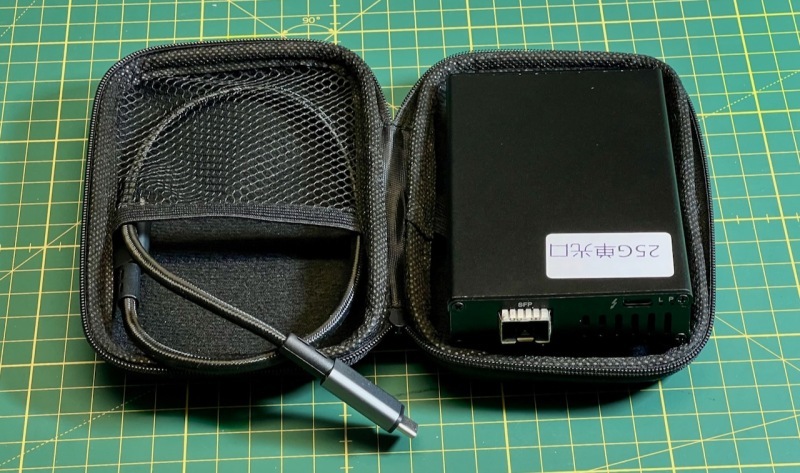
A hardware correspondent recently detailed the discovery and testing of an inexpensive, single-cable Thunderbolt to 25 Gigabit Ethernet adapter, available primarily through online marketplaces. This adapter is notable because it draws power solely from the host machine, making it highly portable for both mobile workstations and desktop setups. The device, identified on macOS as a "PX Thunderbolt to Ethernet" adapter, offers SFP28 ports starting around $157 for the single-port configuration.
The testing revealed strong throughput, with the adapter reaching 20.7 Gbits/sec in one direction and nearly 25.4 Gbits/sec when saturated bidirectionally using iperf3. This performance nears the practical bandwidth ceiling imposed by the Thunderbolt 3 or 4 physical interface. For comparison, this represents a significant improvement over standard networking solutions when handling bidirectional saturation, according to the report published on kohlschuetter.github.io.
However, the primary drawback observed was severe thermal management failure, with the enclosure reportedly becoming too hot to touch during operation. This extreme heat occasionally led to silent connection drops or kernel panics within the macOS network driver. The correspondent noted that while higher-end commercial options exist from companies like ATTO and Sonnet, their pricing was prohibitively high.
Upon disassembly, the adapter was found to be a two-board assembly consisting of a repurposed Mellanox ConnectX-4 Lx EN OCP 2.0 network card and a custom Thunderbolt 3 adapter PCB. The core components are essentially decommissioned server networking gear, which explains the underlying performance capabilities, including support for features like RDMA over Ethernet.
The correspondent hypothesized that the thermal problem stemmed from the poor internal placement of the small Mellanox heatsink between the two stacked printed circuit boards. While the cards themselves are rated for high temperatures, the passive cooling of the compact enclosure proved insufficient under load.
To address the critical heat issue without resorting to a noisy fan, the tester devised a large, external passive cooling solution. By affixing two substantial aftermarket heatsinks to the exterior using a thermal pad, the enclosure temperature was reduced by at least 15 Kelvin, stabilizing core temperatures around 75°C.
Further refinement involved updating the Mellanox firmware, which proved impossible to execute directly from macOS. This necessitated booting a separate Linux machine with Thunderbolt support enabled to utilize the necessary tools, such as the boltctl utility, to enroll and authorize the peripheral device.
This exploration highlights a growing trend where high-speed, server-grade components are being integrated into small-form-factor consumer peripherals via specialized bridge hardware. While the performance potential is evident, the success of these niche devices often hinges on user intervention to overcome inadequate thermal engineering.