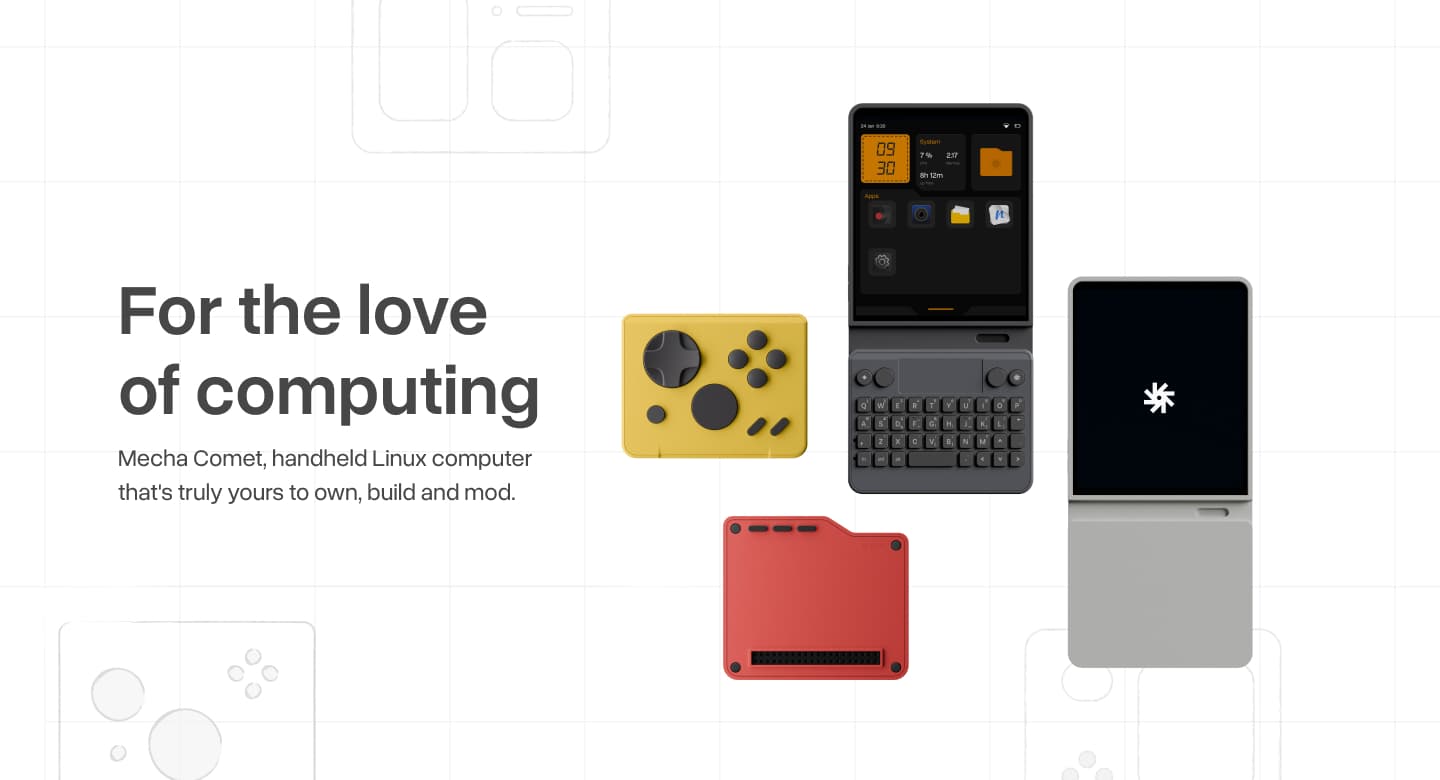
In an era dominated by sealed, subscription-dependent consumer electronics, the Mecha Comet emerges as a bold declaration for true hardware ownership. This new handheld Linux computer, currently seeking community backing via Kickstarter, is engineered from the ground up for the enthusiast, the developer, and the persistent tinkerer.
The core innovation lies in its expansive, magnetic I/O system. Featuring 40 exposed IO pins, the Comet allows users to magnetically snap on modules—from specialized sensors and custom controllers to conventional gamepads—transforming the device's function in seconds. Crucially, Mecha has committed to open-hardware standards for its official extensions, providing the schematics necessary for the community to build and innovate upon the platform.
Beyond mere emulation or indie gaming, the Comet positions itself as a genuine mobile computing utility. It runs a custom Linux distribution, Mechanix, offering granular control over performance and hardware. For IT professionals, it serves as a powerful, portable remote terminal for datacenter management, capable of running network scanners and protocol analyzers directly in the field, potentially leveraging Gigabit Ethernet via USB-C.
Furthermore, the device actively challenges the walled gardens of proprietary smartphones. Users are encouraged to utilize the Linux stack for calls, messaging, and mobile data via add-on modems, fostering an open-source mobile ecosystem. This commitment extends to hardware longevity, with design choices prioritizing repairability and future-proofing.
For the electronics hobbyist, the Comet transforms into a pocket-sized hardware lab. With extensions supporting LoRa for decentralized mesh networking (via Meshtastic) or SDR capabilities, users can prototype complex RF applications. The inclusion of accelerated computer vision (up to 13 TOPS) and support for ROS2 positions it as a viable platform for mobile robotics projects.
This project is fundamentally built on the philosophy that open source drives progress. With the bootloader, kernel, and root filesystem all open, users are empowered to master Linux internals, port applications, and even experiment with real-time operating systems on the secondary MCU. It represents a significant step toward democratizing mobile computing infrastructure.
As the Mecha Comet moves from concept to production via its crowdfunding campaign, it signals a growing appetite for powerful, adaptable, and transparent technology. It’s not just a handheld; it’s a platform designed to be molded, controlled, and expanded by its users, setting a new benchmark for modularity in portable computing. (Source: mecha.so)