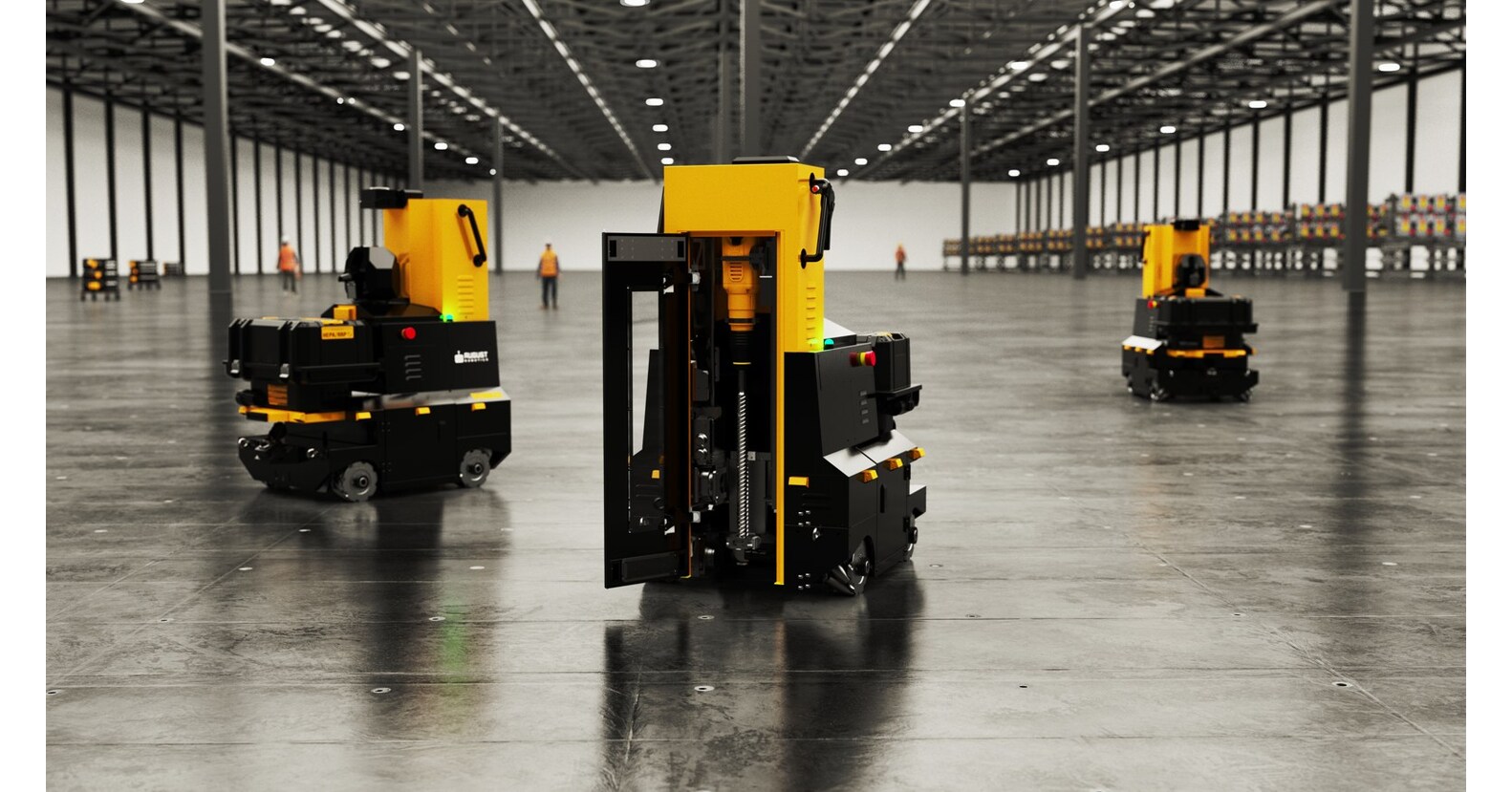
DEWALT, a Stanley Black & Decker brand, announced the launch of the world's first downward drilling, fleet-capable robot, developed in collaboration with August Robotics, aimed at accelerating the construction timeline for data centers globally. This development directly addresses the rapid expansion of over 400 data centers currently under development worldwide, driven primarily by the intense computational needs of artificial intelligence.
The new robotic system utilizes August Robotics' autonomous drilling and fleet orchestration platform to execute crucial structural work, such as drilling thousands of holes for server rack supports and overhead utility installations. During an ongoing pilot program with a leading hyperscaler, the robot demonstrated drilling speeds up to ten times faster than conventional techniques.
Bill Beck, President of Tools & Outdoor at Stanley Black & Decker, stated that construction speed is a critical factor for hyperscalers, who are projected to account for nearly 80% of data center demand. The robotic drilling solution addresses this by delivering schedule acceleration, cost reductions, and enhanced jobsite safety.
Data collected from the pilot confirms significant efficiency gains, showing that the robot reduced construction timelines by 80 weeks across ten separate data center builds. Furthermore, the system achieved remarkable precision, completing over 90,000 holes with 99.97% accuracy in both location and depth.
This technology is positioned to enhance DEWALT's existing data center ecosystem, which already includes vibration-mitigating tools and advanced anchoring solutions. The integration of autonomous drilling capacity offers a substantial boost to the efficiency of foundational construction stages.
The commercial availability of this robotic drilling solution is anticipated in mid-2026, following its demonstration at the World of Concrete Trade Show in Las Vegas. This move signals a growing trend toward specialized automation in large-scale infrastructure projects necessary for scaling AI compute capacity.
This collaboration underscores how established tool manufacturers are partnering with specialized robotics firms to integrate advanced automation into heavy construction workflows. The focus remains on delivering measurable productivity improvements in sectors experiencing exponential growth.