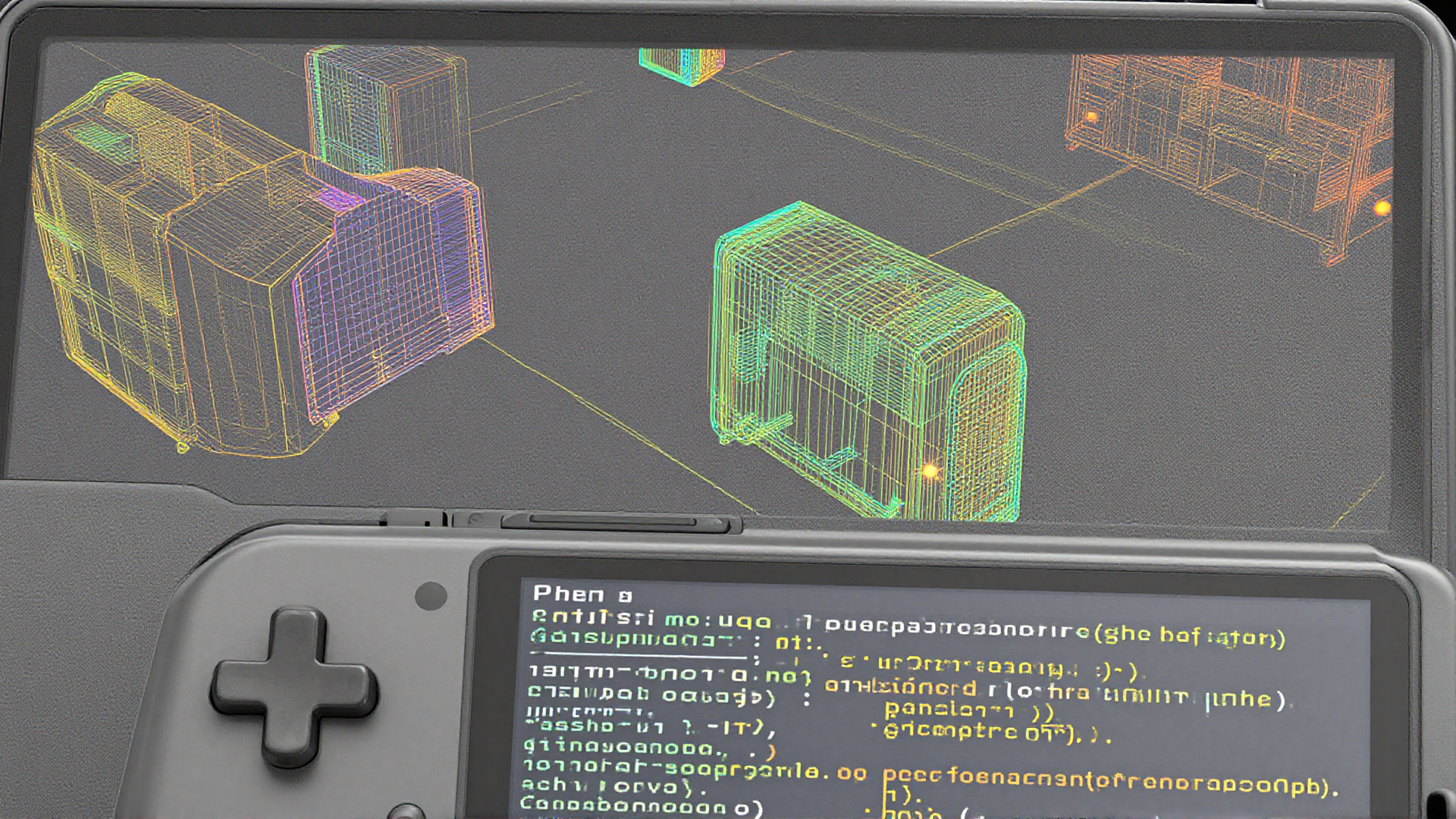
Carl Enlund recently unveiled a novel, self-contained 3D game engine designed specifically for the Nintendo DS, allowing users to write and execute code directly on the handheld console. This project evokes the spirit of early programming environments, such as those found on graphing calculators, by offering a full programming suite in a portable format. The resulting application compiles into a highly efficient, approximately 100KB .nds ROM file.
The engine’s architecture is divided into distinct functional components handling input, logic, and display, according to details published on crl.io. The top screen manages 3D rendering, utilizing the DS's dedicated hardware to draw colored cubes at a smooth 60 FPS, with camera control managed via scriptable parameters. The bottom screen houses a software-rendered, touch-based editor for writing the game logic.
Scripting is handled by a custom interpreter that processes one line of code per frame, avoiding complex runtime parsing overhead. The language supports fundamental programming structures, including variables (labeled A through Z), loops, conditionals, and commands for manipulating 3D model positioning and camera angles. The system includes nine read-only registers for accessing D-pad input and system state, such as elapsed time.
To demonstrate functionality, the engine ships with a fully operational 3D Pong game as its default script, which incorporates basic physics, collision detection, and sound feedback using only the defined scripting commands. This default example showcases how complex behaviors can be constructed using simple mathematical operations and flow control within the limited resource environment of the DS.
The technical implementation relies on C programming combined with the libnds development library, compiled via the devkitPro toolchain. The source code itself is quite lean, comprising roughly 3,100 lines of C, underscoring the efficiency required to run modern-feeling graphical applications on 2006-era hardware.
However, the current iteration imposes several constraints typical of embedded development, including a maximum of 128 script lines, statically sized arrays, and the absence of dynamic memory allocation or subroutines. These limitations reflect necessary trade-offs to ensure execution stability and speed on the dual-screen device.
This creation offers a compelling look at the creative possibilities within constrained hardware ecosystems, potentially inspiring a new wave of homebrew development focused on on-device creation. Enlund has made both the source code and the compiled ROM available for testing, including an option to run the engine within a browser-based Nintendo DS emulator.
Moving forward, the ability to develop and iterate games directly on legacy hardware presents an interesting challenge to modern cloud-based or PC-centric development workflows. The next logical steps might involve integrating more advanced graphical primitives or expanding the scripting language's capabilities beyond simple numeric operations.