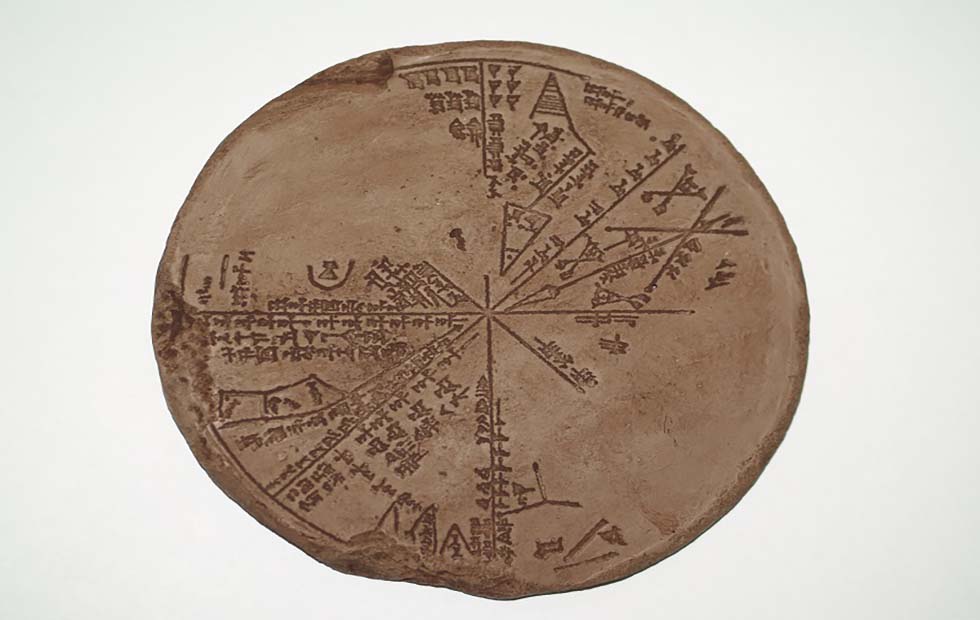
Researchers have reportedly solved a long-standing enigma surrounding a cuneiform clay tablet, designated K8538, housed in the British Museum collection. Discovered in the late 1800s within King Ashurbanipal’s library in Nineveh, Iraq, the artifact was initially believed to be Assyrian, but modern analysis dates its markings to the Sumerian period, approximately 3300 BC.
This artifact, functioning as an early astronomical instrument or “Astrolabe,” features a segmented disk charting the night sky with inscribed angular measurements, though nearly forty percent of the planisphere is missing due to damage sustained during the sacking of Nineveh. The core assertion, detailed by Alan Bond and Mark Hempsell in their 2008 publication, is that the tablet records the Köfels Impact Event, a massive landslide in Austria whose origins have puzzled geologists since the nineteenth century.
Geological evidence at Köfels points toward immense pressures and explosive vaporization, yet the absence of a traditional impact crater has led many modern researchers to dismiss an extraterrestrial cause. However, utilizing modern computational models to simulate ancient trajectories, scholars correlated the tablet’s recorded celestial positions with the night sky of June 29, 3123 BC (Julian calendar).
The tablet’s inscription reportedly details the trajectory of an object over one kilometer in diameter while it was still in space, aligning with an Aten-class asteroid whose orbit brings it close to Earth. The trajectory calculated from the Sumerian data shows a very low entry angle of six degrees relative to the landscape.
This low-angle approach is crucial, as it suggests the object clipped the Gamskogel mountain eleven kilometers from Köfels, causing it to fragment and explode before reaching the final impact zone. This pre-impact airburst would have pulverized the rock at Köfels, generating the observed landslide without creating a classic impact crater, according to the researchers’ analysis.
Mark Hempsell noted that the resulting atmospheric plume from the explosion would have been bent over the Mediterranean, re-entering the atmosphere above the Levant and potentially causing widespread thermal ignition events. This suggests the immediate blast zone in the Alps may not have accounted for the majority of casualties associated with the event.
This reinterpretation of the Planisphere tablet underscores the sophisticated observational astronomy achieved by Sumerian scholars millennia ago. The ability to accurately record and map the path of a near-Earth object impacting a specific terrestrial location provides compelling evidence of their advanced mathematical and astronomical practices.
Future research will likely focus on corroborating the atmospheric effects described by Hempsell with paleoclimatic data from the Eastern Mediterranean region. The ongoing study of this single artifact offers profound insights into early human understanding of cosmic hazards and their impact on early civilization.