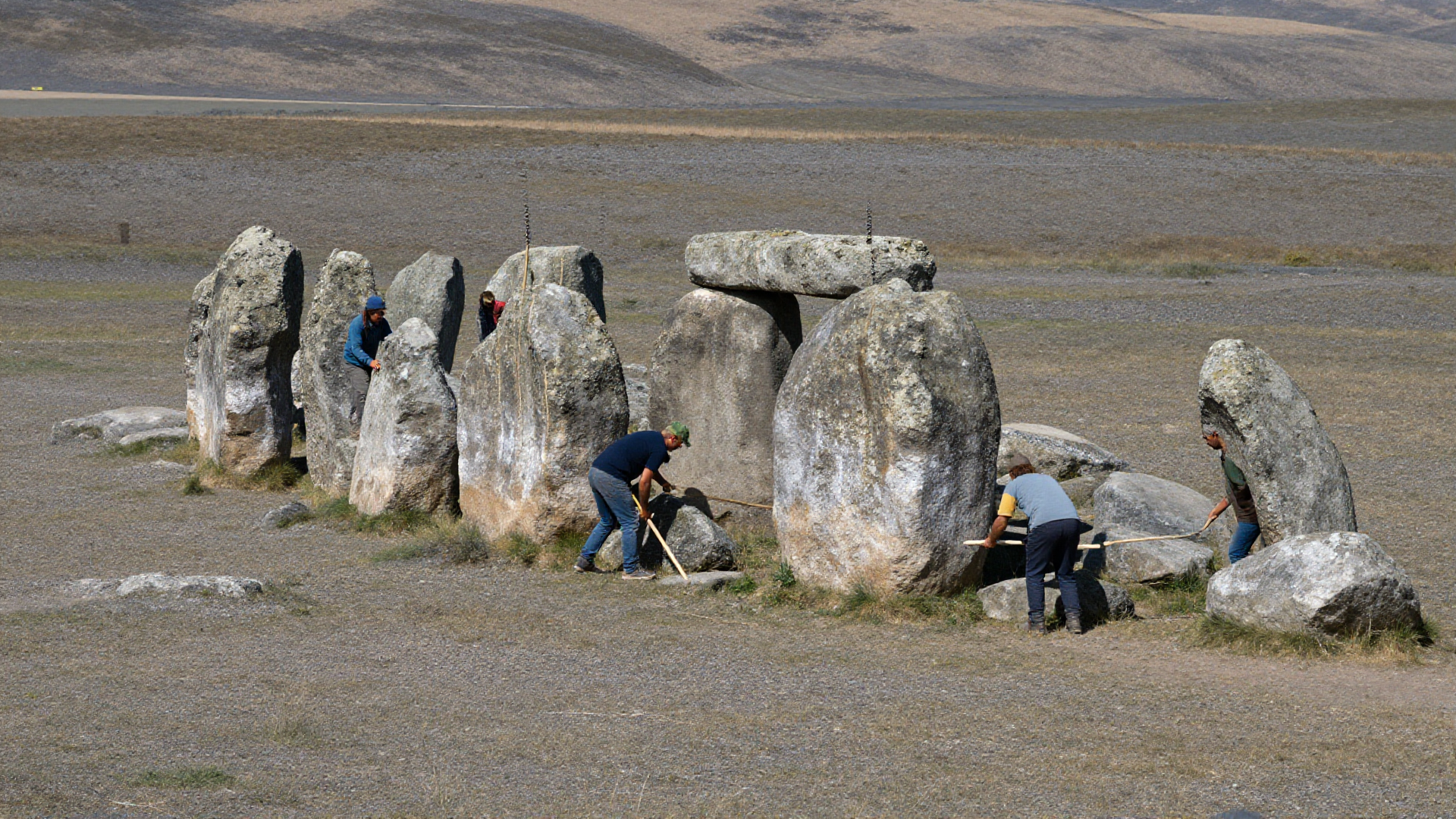
Researchers at Curtin University announced compelling new evidence this month indicating that ancient humans transported the stones used to construct Stonehenge, challenging long-held theories involving glacier movement. The findings, published in the journal Communications Earth & Environment, zero in on the transport mechanism for the monument’s massive sarsen stones.
Previous chemical analyses confirmed that many of the stones originated from distant quarries, notably those in Wales and northern Scotland. The central debate has long centered on whether glaciers moved the bluestones part of the way to Salisbury Plain or if human effort achieved the entire relocation.
Curtin University’s Anthony Clarke and his co-authors employed mineral fingerprinting to analyze hundreds of zircon crystals collected from rivers adjacent to the historic site. The team specifically searched for evidence of Pleistocene-era sediment deposits that would result from the slow erosion of transported rocks.
According to Clarke, if the stones had traveled significant distances via ice sheets or meltwater flows from northern regions, a distinct mineral signature would be detectable in the surrounding sediment. The absence of this expected signature significantly weakens the glacial hypothesis for the transport of these specific materials.
This research builds upon prior work by Clarke’s team, which in 2024 successfully traced the Stonehenge Altar Stone to the Orkney region in northeastern Scotland. That discovery already pointed toward a massive, intentional human effort spanning hundreds of miles.
The current data provides the strongest scientific affirmation to date that prehistoric populations possessed the logistical and engineering capacity to move the heaviest components of the monument over land. This reinforces a view of Neolithic peoples as highly sophisticated builders and planners.
Further research may now shift focus from *how* the stones were moved to the precise construction techniques utilized once the materials arrived at Salisbury Plain. Understanding the full scope of this ancient logistical feat remains a key area for archaeological investigation.