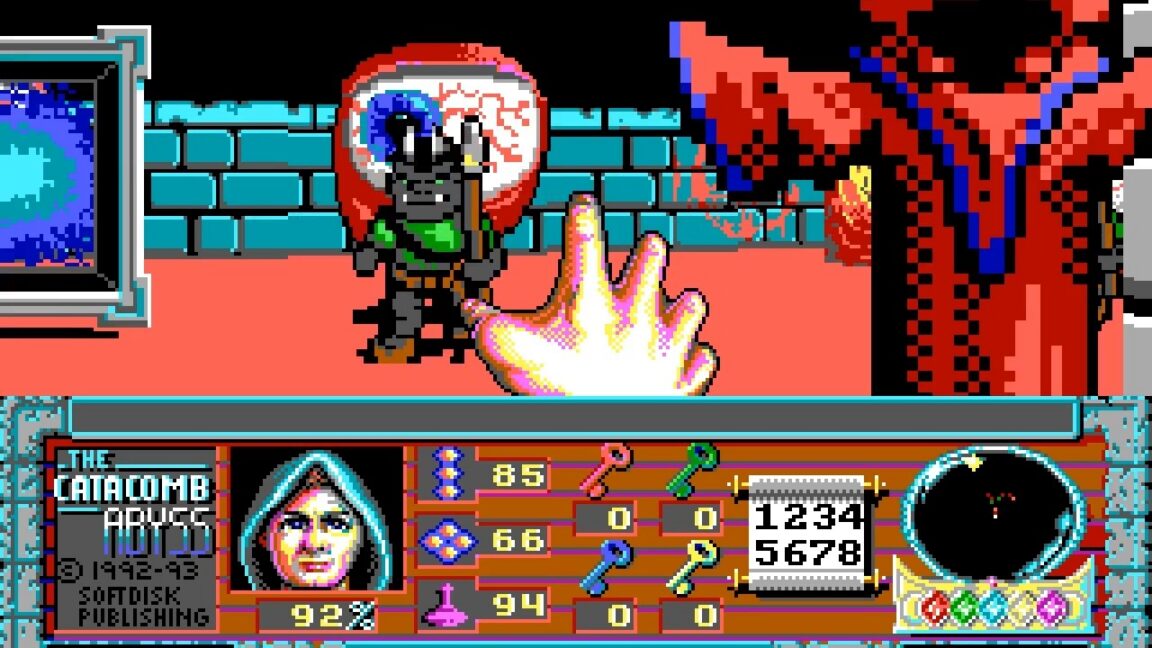
id Software co-founder John Romero recently gathered the company's founding members for a retrospective video examining the development of Catacomb 3D, the seminal first-person game that directly informed Wolfenstein 3D. This look back comes nearly 35 years after the original release of the often-overlooked title, which established several core id Software mechanics.
Catacomb 3D featured several innovations, including support for mouse input and the use of color-coded keys to solve environmental puzzles, alongside the ability to shoot walls to reveal hidden areas. However, reports from Ars Technica indicate the game almost steered the company toward a less sustainable, arcade-centric design philosophy.
Technologically, the 1991 game was built upon the framework of id's earlier fast-paced title, Hovertank One. The most significant graphical advancement in Catacomb 3D was the introduction of texture-mapped walls, a concept John Carmack pursued actively. Carmack cited seeing a texture-mapped cube illustration in his textbook, The Fundamentals of Computer Graphics, as a primary visual motivator for the feature.
Romero recounted that he learned about texture mapping from Paul Neurath, who was successfully employing the technique in the development of Ultima Underworld. Romero relayed this information to Carmack, who reportedly paused before confirming his ability to implement the concept into their engine.
John Carmack noted that the game retained some of the simplified mentality of its predecessor, the original Catacomb, which was a clone of Gauntlet. Carmack expressed that the early iteration lacked the narrative depth and overarching story structure that many felt suited the PC platform better at the time.
This pushback demonstrated the internal tension between creating fast, twitch-action games and conforming to the developing expectations for PC gaming narratives. The team ultimately prioritized action, affirming their belief that fast-paced gameplay remained a viable and compelling direction for the studio.
The lessons learned and the technical breakthroughs achieved in Catacomb 3D proved crucial, directly paving the way for the commercial success of Wolfenstein 3D and subsequently Doom. The retrospective highlights the iterative process where early experiments solidify foundational elements for future industry-defining products.
This historical examination underscores how early technical exploration, even in seemingly forgotten titles, sets the trajectory for major shifts in game design and engine architecture. The techniques developed then continue to influence how immersive 3D environments are rendered today.