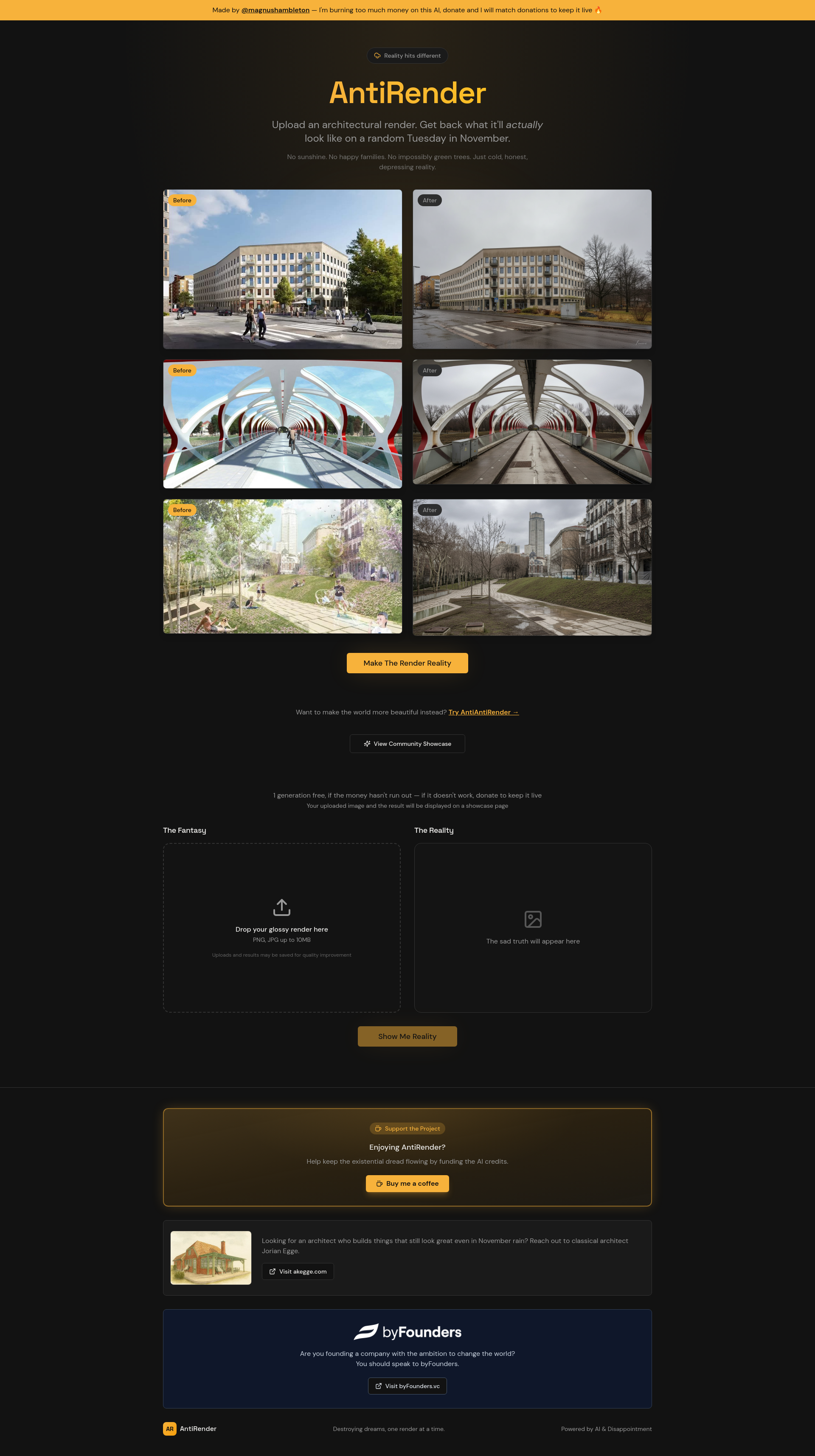
Developer Magnus Hambleton has launched AntiRender, a novel generative AI application designed to strip idealized architectural renderings of their glossy veneers. The tool processes submitted images and outputs visualizations reflecting what the space might actually look like on an unremarkable day, such as a Tuesday in November, according to the project’s debut announcement on antirender.com.
This service directly challenges the industry standard of presenting photorealistic renders bathed in perfect sunlight with impossibly vibrant foliage. AntiRender instead simulates less appealing environmental factors, aiming to provide a more grounded expectation for built projects. The developer explicitly states the goal is to show the “cold, honest, depressing reality” often omitted from promotional materials.
The application currently offers users one free generation, contingent upon its operational funds remaining available. Hambleton has implemented a donation matching system to incentivize community support needed to keep the servers running. This funding model underscores the high computational expense associated with running complex generative models on user-uploaded content.
AntiRender utilizes underlying diffusion or generative adversarial network (GAN) technology, though the specific model architecture was not detailed in the initial release notes. The process involves taking the input image and applying stylistic and environmental transformations conditioned on achieving maximum mundanity, a unique constraint set for image synthesis.
Uploads and resulting comparisons are featured on a public showcase page, allowing users to view the transformation from 'Fantasy' to 'Reality.' The platform notes that uploaded images and results may be retained for future quality improvement and model refinement, indicative of an iterative development process.
By focusing on the unvarnished truth of built environments, AntiRender taps into a growing sentiment among consumers and observers wary of speculative rendering accuracy. This approach contrasts sharply with standard visualization workflows that prioritize aspirational aesthetics over practical environmental simulation.
For the architecture and real estate technology sectors, AntiRender presents an interesting case study in applying AI for de-optimizing visual output. The longevity of the tool will likely depend on community financial backing and whether architects begin integrating such 'reality checks' into their pre-construction visual workflows.
Moving forward, the success of AntiRender hinges on its ability to maintain high-quality, contextually accurate transformations while balancing operational costs against user adoption. Hambleton’s direct appeal for funding highlights the financial realities facing independent developers building resource-intensive AI utilities.